Exploring English Castles by Edd Morris
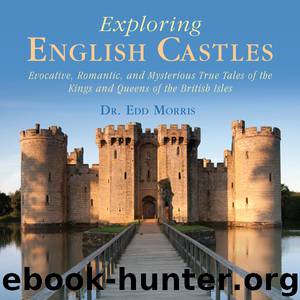
Author:Edd Morris
Language: eng
Format: epub
Publisher: Skyhorse Publishing
Published: 2015-01-01T05:00:00+00:00
After the successful invasion of William the Conqueror, those in the southern counties of Medieval England were understandably perpetually jumpy about any potential threat from the channel. In the mid-1300s—when England was a much more stable place than in those centuries prior—the specter of invasion once again reared its head as a consequence of the Hundred Years’ War, where England battled within France. The French troops upon the opposing side were restrained only by the choppy waters of the English Channel and, in 1377, their forces managed to cross the water and burned and sacked the nearby towns of Rye and Folkestone.
The construction of Bodiam Castle likely began about ten years later, during the tail end of the 1380s. In accordance with a number of other medieval castles, Sir Edward sought permission from the king to build such a castle, and this was granted in 1385.
Some historians have interpreted this license to crenellate, and the timing of construction of the castle, to indicate that Bodiam was built in response to a real French threat. Other historians have argued that the 1377 coastal raid was the final salvo from the French side and, by 1385, the threat of French invasion was entirely over. In addition, they argue that the license to crenellate was pure medieval pomp, and the document boasted had little real-world significance.
Whichever side you fall, there’s no doubt that Bodiam was one of the very last castles to be built in England during the medieval period. The majority of fortresses were finished during the 1100s and 1200s. Dunstanburgh Castle (see page 188) was built at a comparatively late stage, but construction took place in the late 1320s—some sixty years before work on Bodiam began. Chronologically, Bodiam was probably the last castle to be built in Medieval England.
A License to Crenellate
Want to build a castle? Well, in the Middle Ages, you might have needed a license for that. Back in Medieval England, nobles wishing to construct a castle ostensibly had to apply to the king for a “license to crenellate,” should they have wished to build a fortified castle or manor-house. Crenellations, if you’re wondering, refer to the up-and-down notches that you’ll often see along the top of a castle wall—they’re also sometimes referred to as battlements.
Download
This site does not store any files on its server. We only index and link to content provided by other sites. Please contact the content providers to delete copyright contents if any and email us, we'll remove relevant links or contents immediately.
Spell It Out by David Crystal(36123)
Underground: A Human History of the Worlds Beneath Our Feet by Will Hunt(12106)
A Year in the Merde by Stephen Clarke(5444)
Venice by Jan Morris(2584)
Claridge's: The Cookbook by Nail Martyn & Erickson Meredith(2413)
My Paris Kitchen: Recipes and Stories by Lebovitz David(2303)
A TIME OF GIFTS by Patrick Leigh Fermor(2214)
The Plantagenets by Dan Jones(2099)
Welcome to the Goddamn Ice Cube by Blair Braverman(2059)
The Finnish Way by Katja Pantzar(2007)
Top 10 Prague (EYEWITNESS TOP 10 TRAVEL GUIDES) by DK(1997)
Bang Poland: How To Make Love With Polish Girls In Poland by Roosh V(1990)
From Russia with Lunch by David Smiedt(1988)
The Isle of Mull by Terry Marsh(1957)
A TIME TO KEEP SILENCE by Patrick Leigh Fermor(1920)
Rick Steves London 2018 by Rick Steves & Gene Openshaw(1876)
Insight Guides Experience Tokyo by Insight Guides(1867)
A Taste of Paris by David Downie(1866)
Merde in Europe by Stephen Clarke(1781)
